
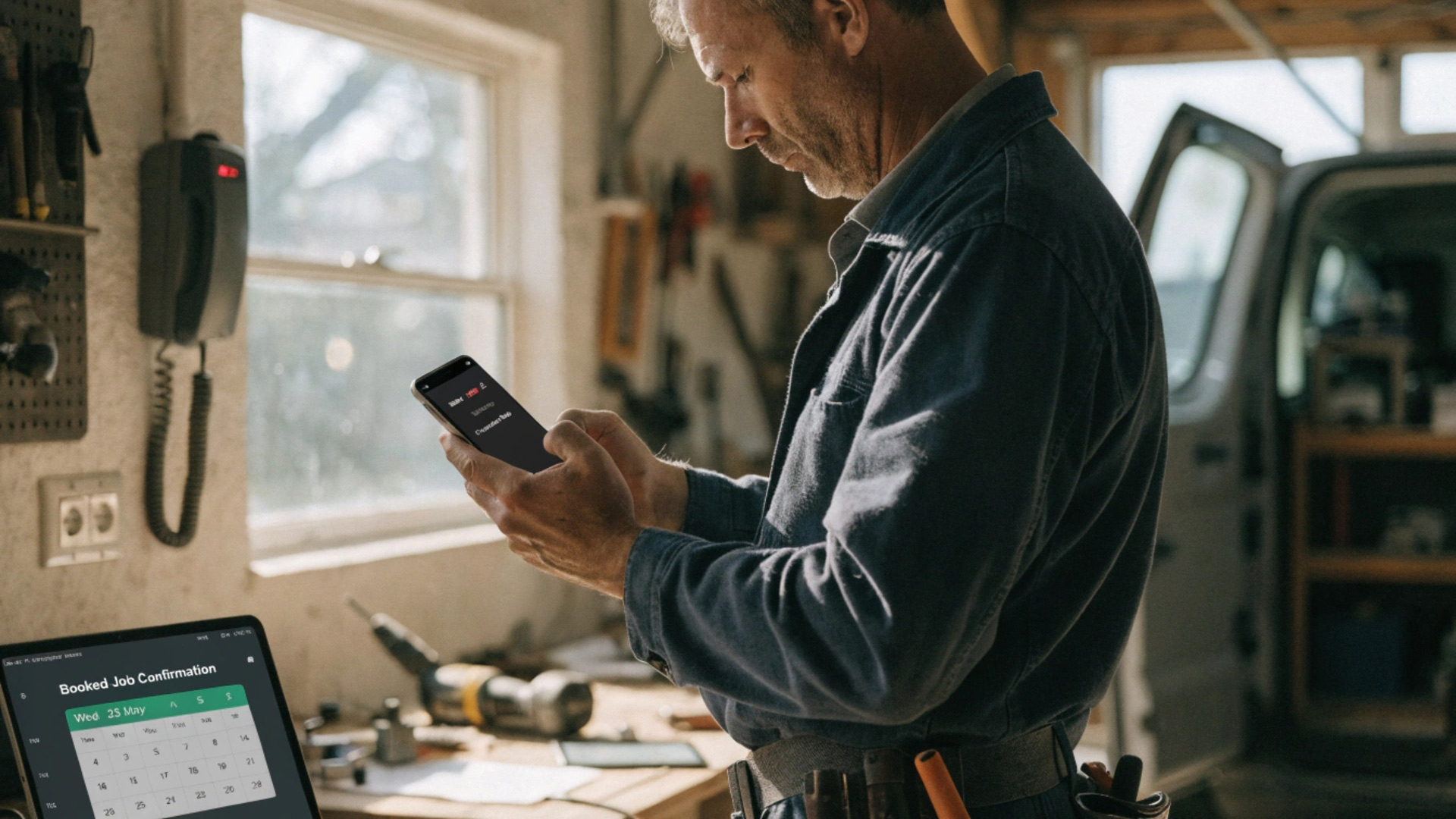
A homeowner with a dead AC unit does not leave a voicemail and wait. They call the next contractor. That is the whole problem in one sentence, and it is why how you handle inbound calls is one of the highest-leverage decisions in a home service business.
Invoca's 2026 home services benchmarks, built on a dataset of more than 70 million calls, found that only 52 percent of callers to home service businesses reach a person. In HVAC it is 34 percent. Of the leads that do get answered, 45 percent convert on that call. The phone is where the job is won. The question is who, or what, is answering it.
You have four real options. Here is how they compare, and which one fits which kind of shop.
Voicemail is the default, and for a home service business it is the most expensive option that looks free.
Here is why. Fewer than 3 percent of callers who reach voicemail leave a message, per Invoca. The other 97 percent hang up, and most of them call a competitor. You are not capturing a lead to call back later; you are handing it away. Voicemail takes no appointment, answers no question, and does nothing at 9 p.m. when the emergency call comes in.
Where it fits: a solo operator with no budget who accepts that after-hours calls are lost. For anyone trying to grow, it is a leak, not a plan.
A traditional answering service puts a live agent at an offsite call center on your line. They answer using a script you provide, take a message, and route or transfer the call. Many run 24/7, which is the main reason contractors use them.
Where it wins: it is a human voice, around the clock, at a lower entry price than a virtual receptionist. For a high volume of routine, repetitive calls where a message is enough, it does the job.
Where it fails a home service business: the agent handles many companies and does not know yours, so callers get scripts, hold times when calls stack up, and the occasional misheard address or wrong transfer. Basic plans take a message rather than book the job, and not all of them connect to Jobber, Housecall Pro, or ServiceTitan, so you get a manual handoff that can slip. And the billing is per minute, so the cost climbs on your busiest days, which are the exact days you most need calls answered. A busy shop commonly spends $500 to $1,000 or more a month, and the number is hard to predict.
A virtual receptionist is a step up from an answering service: a live human trained to answer as your brand, hold a fuller conversation, capture the lead, and book the appointment. It is the most personal of the options.
Where it wins: a branded, human front desk. For relationship-driven businesses that want every caller to feel handled by a real person, it delivers.
Where to check carefully for a home service business: hours vary by provider. Some run standard business hours unless you pay for extended coverage, which leaves nights and weekends uncovered, and that is when a lot of trade calls and the big emergency jobs come in. Others, Ruby among them, advertise around the clock, so ask directly. It is also the most expensive of the human options, often $300 to $2,000 or more a month. One provider example cited in an industry comparison runs $1,299 a month for 300 calls, with each call beyond that at $6.99. And because it is staffed by people, the experience varies by which person picks up.
An AI answering service is software that holds a real, natural conversation, not a phone tree. It greets the caller, answers common questions, qualifies the lead, books the job into your calendar, and hands off to a human when a call is genuinely complex or unusual.
Where it wins for the trades: it answers on the first ring, 24/7, and it handles unlimited calls at the same time, so it never rings out and never puts a caller on hold. It books straight into your scheduling software, so a call becomes a job on the calendar instead of a message you deal with later. Pricing is flat monthly with no per-minute meter, so a heavy call day does not spike the bill. And it commonly covers Spanish at the same rate rather than as a surcharge.
Where to be clear-eyed: an AI answers routine and repetitive calls consistently and escalates the unusual ones to a person. It is a front desk that never sleeps, not a replacement for every judgment call your best tech makes. Set up well, that is exactly what most inbound calls need.
If the labels blur together, this is the honest one-line version:
An answering service takes a message. A virtual receptionist runs your front desk during business hours. An AI answering service runs your front desk 24/7 and books the job.
The axes that actually matter are who or what answers, what hours it covers, whether it books the job or just takes a message, and how you pay for it.
Match the option to your shop.
Cactus is an AI answering service built for home service contractors. It answers every call around the clock, books appointments straight into Jobber and Housecall Pro, handles English and Spanish with automatic switching, and goes live in 48 to 72 hours on flat monthly pricing with no per-minute charges. It handles the routine calls that make up most of your volume and escalates the ones that need a person. If your problem is missed calls and messages that never turn into booked jobs, that is the gap it closes.
It also carries the Triple-Return Guarantee: if Cactus does not put at least 3x your monthly investment back in your pocket in new revenue, that month is free. Most of this category offers a free trial, and a couple offer a refund if you are unhappy. Of the eighteen providers we reviewed, none published a guarantee tied to a business result.
The best way to judge it is to hear it. Call the demo line at (415) 903-6007 and talk to it the way a customer would.
What is the difference between an AI answering service and a traditional answering service?
A traditional answering service uses live offsite agents who read from a script and mainly take a message. An AI answering service is software that holds a real conversation, answers questions, and books the appointment into your scheduling software on the call, 24/7, with flat monthly pricing instead of per-minute billing.
What is the difference between an answering service and a virtual receptionist?
An answering service picks up, gives general responses, and takes a message, usually around the clock and at a lower cost. A virtual receptionist is a live human trained to act as an extension of your business, handling fuller conversations and booking appointments, but usually only during business hours and at a higher cost.
Is an AI answering service better than voicemail?
For a business, yes, by a wide margin. Fewer than 3 percent of callers who reach voicemail leave a message, so voicemail loses most of the calls it takes. An AI answering service answers the call live, so the lead is captured and often booked instead of lost.
Can an AI answering service really book appointments?
Yes. A capable AI answering service checks your availability and books the job into your calendar or CRM during the call, then confirms by text. Cactus books directly into Jobber and Housecall Pro.
Will an AI answering service handle Spanish-speaking callers?
A good one will, often at no extra charge. Cactus handles English and Spanish and switches automatically based on the caller, where a traditional service usually charges a surcharge for bilingual coverage.
Hear it for yourself before you decide. Call the Cactus demo line at (415) 903-6007 and talk to the AI the way your customers would. Or book a walkthrough and we will show you what it books in your first week.
© Copyright Cravd Inc. 2026. All rights reserved.